

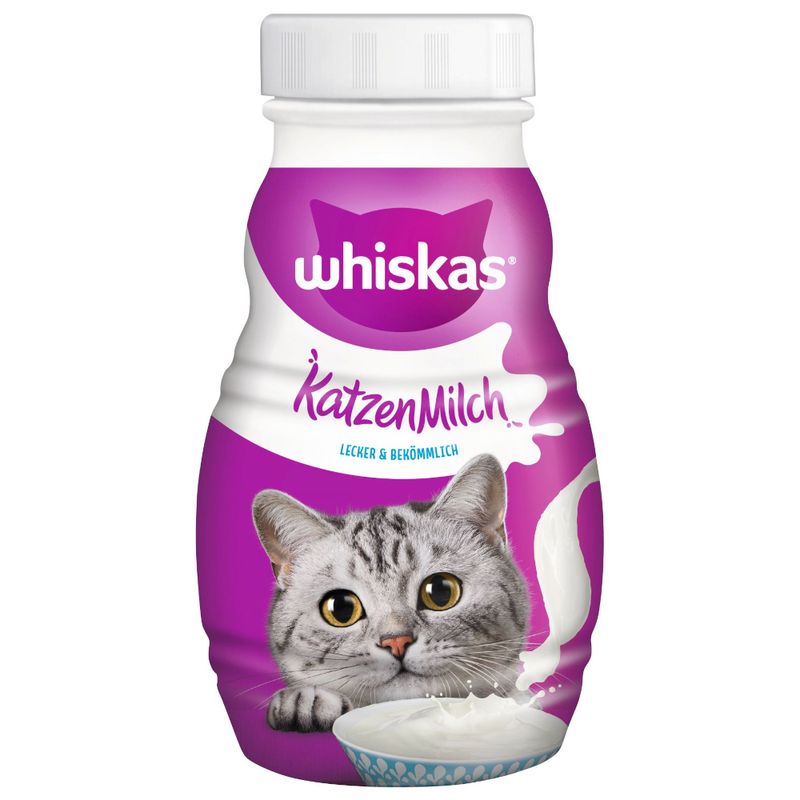
Whiskas Cat Milk is a specially formulated milk-style dietary supplement for cats, presented as an easily digestible liquid in a resealable bottle with a screw cap for portion control. It is described on the label as having less lactose than cow’s milk to improve tolerability and as highly palatable; the label lists milk and dairy products, vegetable by-products, sugar and minerals, and notes added vitamin D3, vitamin E, biotin and taurine. The product is presented as a dietary supplement and is suitable for cats over six weeks old. Energy content is listed as 48 kcal/100 g; specific feeding limits are not stated on the label.
At a Glance
Whiskas Cat Milk is a liquid milk-style dietary supplement for cats, supplied in a resealable bottle with a screw cap for portion control. The label states it contains less lactose than cow’s milk for improved digestibility and lists ingredients including milk & dairy products, vegetable by-products, sugar and minerals, plus added vitamin D3, vitamin E, biotin and taurine. Energy is given as 48 kcal/100 g.
| Treat Type | Dietary supplement |
|---|---|
| Format & Texture | Liquid milk, resealable bottle with screw cap |
| Main Protein | Milk & dairy products |
| Package Sizes | Great value 6-pack |
| Calories & Energy | 48 kcal/100 g |
| Max Daily Amount | Not stated |
| Use | Milk-style dietary supplement for cats |
| Made In | Not stated |
Ingredients & Feeding Notes
This section covers both the ingredient composition and how Whiskas Cat Milk is intended to be used, based strictly on the product label and product page. It summarises what is listed in the ingredients and additives and then outlines any stated or missing guidance for feeding and portioning.
| Main protein sources |
|
|---|---|
| Carbohydrate & fiber sources |
|
| Fats & oils |
|
| Added vitamins, minerals, or supplements |
|
The label identifies Whiskas Cat Milk as a milk-style dietary supplement for cats and states it is suitable for cats over six weeks old; it also highlights a resealable bottle with a screw cap for portion control. No maximum daily amounts, explicit serving sizes, or feeding frequencies are stated on the product page. Given that absence, purchasers should treat the product as an occasional supplement: pour small amounts into a dish, use the resealable cap to limit servings, and introduce it gradually so the cat’s tolerance can be observed. Use as a supplementary serving rather than a replacement for complete food, and follow any additional guidance printed on the current product packaging. Label transparency is mixed: the product provides clear ingredient entries and lists added vitamins and their amounts, and energy is given as 48 kcal/100 g, along with analytical constituents such as protein (3.7%), fat (3.3%), fibre (1.7%), ash (0.7%), calcium (1260 mg/kg), phosphorus (0.1%), and moisture (87.2%). However, the label does not provide practical portion sizes or maximum daily allowances, which limits precise portion awareness for caregivers.
Users Commonly Mention
This section summarises recurring themes from the available user comments, based only on the provided feedback. It highlights what owners commonly report about Whiskas Cat Milk without adding new claims.
- High palatability: Users frequently mention that their cats love the taste and readily drink the milk, often describing it as a favourite treat.
- Resealable screw cap and portioning convenience: Several reviews note the screw-top lid is handy for keeping the product fresh and allowing portion control; one comment states an opened bottle can last about a week.
- Questions about label guidance on consumption: Some reviewers report seeing a label note about limited consumption (for example, ‘only one bottle per week’) and express uncertainty or concern about what the guidance means in practice.
- Some reviewers report switching from cow’s milk and say they prefer this product for their cats, mentioning it as a treat their cats actively seek.
- A few comments compare cost and availability, noting that cheaper own-brand alternatives can sometimes be acceptable to cats.
Good & Bad
A concise summary of notable strengths and weaknesses based on the label information and available user feedback.
- Ingredient list and additives are explicitly stated, including declared amounts for vitamin D3, vitamin E, biotin and taurine, which clarifies what the product contains.
- Resealable bottle with a screw cap is practical for portion control and freshness; users report an opened bottle can last about a week.
- Multiple user comments consistently report high palatability, with many cats readily consuming the milk-style supplement.
- Energy and analytical constituents are provided (48 kcal/100 g and listed protein/fat/fibre/moisture values), offering some calorie transparency.
- Feeding guidance is unclear: the label does not provide specific serving sizes or maximum daily amounts, and some users note confusing advice such as ‘only one bottle per week’.
- Fats and their sources are not specified on the label, limiting detail about fat composition.
- Product origin and explicit portioning guidance by life stage are not stated on the product page.