

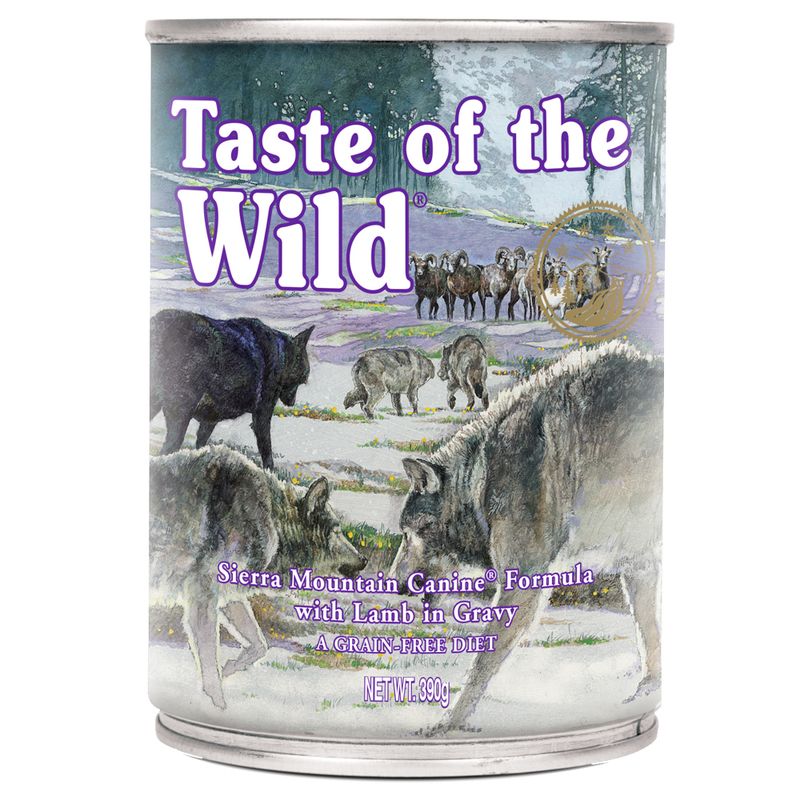
Taste of the Wild – Sierra Mountain Canine is a complete wet food for adult dogs featuring roast lamb and chicken in a grain-free recipe enriched with fruits and vegetables. The review focuses on ingredients, analytical constituents, labeling claims, and declared omega-3 sources.
It will also assess feeding recommendations, antioxidant-rich components such as blueberries and raspberries, and the product’s suitability for dogs with sensitivities, including practical portion guidance and mineral chelation claims.
Quick Overview
Taste of the Wild – Sierra Mountain Canine is a ready-to-serve canned diet formulated for adult dogs, listing lamb (28%) and chicken (14%) among primary animal ingredients and presented as grain-free. Label information highlights added fruits and vegetables, chelated minerals, and declared omega-3 fatty acids; a feeding chart is provided for dogs from about 0–5 kg up to 45 kg.
The guaranteed analysis and ingredient list show high moisture (78.0%), crude protein 8.0% and crude fat 6.0%, with dried blueberries, raspberries and tomatoes noted for antioxidant and plant-fibre contributions. Label facts indicate a grain-free, lamb-forward adult wet food that emphasizes fruit- and vegetable-derived antioxidants, chelated minerals and declared omega-3s, though the label does not provide a detailed breakdown of omega-3 sources or explicit daily calorie targets by weight.
At a Glance
This section summarises label-declared facts for quick reference. The table below lists only information explicitly stated on the product label or product page.
Entries marked “Not stated” indicate the label did not provide that specific detail.
| Food type | Wet |
|---|---|
| Diet completeness | Complete wet food |
| Life stage | Adult |
| Size or breed targeting | Not stated |
| Main protein or flavor | Lamb (28%), Chicken (14%) |
| Package sizes | Not stated |
| Calorie or energy information | 101.0 kcal/kg |
| Country of manufacture | Not stated |
| Nutritional standard | Not stated |
Ingredients & Nutrition
This section reviews the product’s declared ingredient list and guaranteed analysis as printed on the label. The table below extracts only items that are explicitly listed on the product information provided.
| Main protein sources |
|
|---|---|
| Carbohydrate or fiber sources |
|
| Fats or oils |
|
| Added vitamins, minerals, or supplements |
|
The guaranteed analysis declares crude protein 8.0%, crude fat 6.0%, crude fibre 0.5%, ash 2.5% and moisture 78.0%, with an energy value listed as 101.0 kcal/kg. Because this is a wet (canned) product with high moisture, the percentages on an as-fed basis are diluted by water. Converting to a dry-matter basis (subtracting the 78.0% moisture) gives an approximate dry-matter protein of about 36% and dry-matter fat of about 27% — these are simple calculations based on the label values and not a substitute for manufacturer-provided dry-matter information.
Label-based observations: the product explicitly lists primary animal ingredients with percentages for lamb and chicken, declares added fruits and vegetables (blueberries, raspberries, tomato) and specifies both vitamin and mineral additives with stated compound forms for several trace minerals. Missing or not detailed on the label are precise omega-3 quantities and the specific omega-3 fatty acid types, package size options, country of manufacture and any referenced nutritional standard (e.g., AAFCO or FEDIAF).
Best Feeding Guide
Below are the label-declared daily feeding recommendations for Taste of the Wild – Sierra Mountain Canine. Values are provided for this product as a complete wet food and are expressed in cans per day by dog weight.
| Dog’s weight | Cans per day |
|---|---|
| 0-5kg | 1 |
| 12kg | 2 |
| 25kg | 3 |
| 35kg | 4 |
| 45kg | 5 |
Ensure fresh drinking water is always available.
Users Commonly Mention
This section summarises recurring themes from available user reviews on reputable retailers or platforms mentioned in the provided context. It aggregates commonly reported observations about palatability, mixing with dry food, digestion, and product appearance.
- Users frequently mention strong palatability, reporting the food is well accepted by fussy and senior dogs; some reviewers note it has been used as part of weight-management feeding due to a relatively low fat content.
- Some reviewers note the product mixes well with dry food and is used to add moisture to kibble, improving acceptance for dogs reluctant to switch diets.
- Several users report good stool quality and easy digestion after feeding this product, describing consistent acceptance without reported digestive upset in those comments.
- A few comments observe that the product’s visual appearance may not be appealing to owners (appearance may not look appetising), even when dogs still eat it readily.
Good & Bad
This section highlights the main advantages and limitations based on label facts and the provided user feedback. The points are derived from declared ingredients, analytical values, feeding guidance and recurring user comments.
- Labelled as a complete wet adult food with specified primary animal ingredients: Lamb (28%) and Chicken (14%).
- Presented as grain-free with added fruits and vegetables; the label explicitly lists vitamins and trace minerals and notes the presence of chelated minerals.
- Wet format with high moisture can add hydration when mixed with dry food; several users report it mixes well with kibble and is readily accepted by fussy or senior dogs.
- Guaranteed analysis on an as-fed basis shows modest percentages (8.0% protein, 6.0% fat) because moisture is high (78.0%); the label does not provide explicit dry-matter values or a complete breakdown of omega-3 quantities.
- Key label details are missing from the provided information: specific omega-3 types/amounts, package size options, country of manufacture and any referenced nutritional standard (e.g., AAFCO or FEDIAF) are not stated.
- Some users note the product’s visual appearance may not be appealing to owners, even when dogs accept the food.
- Feeding guidance is given as cans per day for discrete weight points (e.g., 0–5 kg, 12 kg, 25 kg, etc.), rather than a continuous range for all weights, which may require interpretation for intermediate weights.