

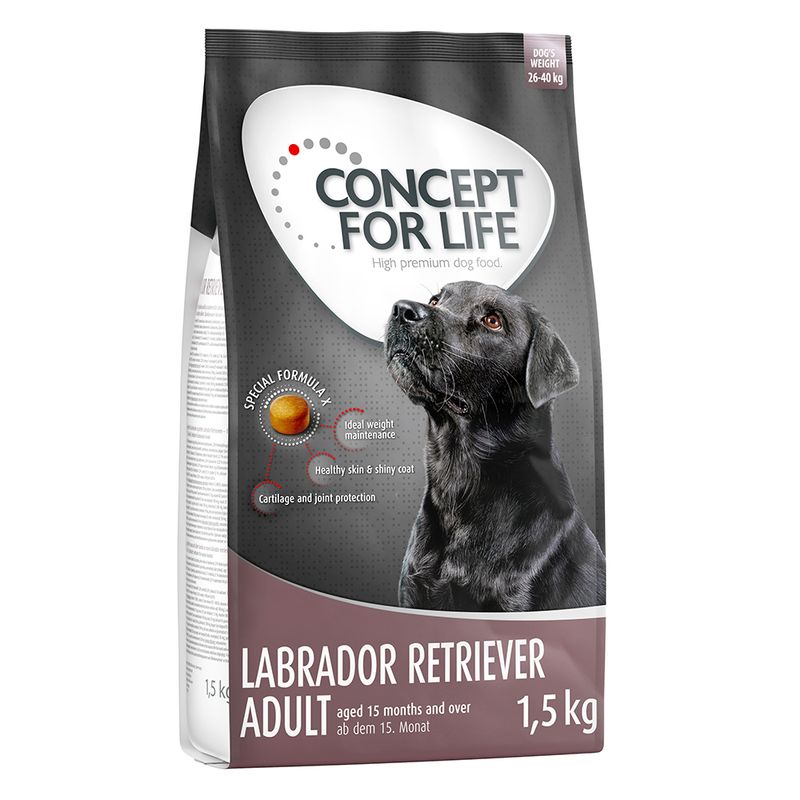
Concept for Life Labrador Retriever Adult is a complete dry food for adult Labrador Retrievers, made with protein-rich chicken and a recipe intended to support joints, weight and digestion. The kibble shape and tailored energy content address the breed’s appetite and chewing behavior.
This review evaluates ingredients, labeling, stated claims and public feedback, focusing on glucosamine, chondroitin and digestible protein. It assesses clarity of information and practical points for owners choosing breed-specific nutrition.
Quick Overview
Concept for Life Labrador Retriever Adult is a breed-specific complete dry food formulated for adult Labrador Retrievers. The label presents a tailored nutrient profile with adapted energy levels and satiating fibre, a specially shaped kibble to slow intake, and added glucosamine and chondroitin sulphate alongside highly digestible poultry protein and prebiotic sources aimed at supporting digestion.
Core takeaway: a nutritionally tailored adult formula that prioritises joint-support ingredients, controlled energy and digestibility for typical Labrador-sized dogs. The packaging notes feeding guidelines covering dogs around 26–40 kg and a recent recipe/packaging update; however, the label does not provide information on manufacturing location, external certifications, or long-term clinical outcome data.
At a Glance
Below are the label facts and explicit product-page details for Concept for Life Labrador Retriever Adult. The entries reflect only information shown on the product label or product page.
The table lists core attributes such as formulation, life stage, primary protein and available pack sizes.
| Food type | Dry |
|---|---|
| Diet completeness | Complete feed |
| Life stage | Adult |
| Size or breed targeting | Labrador Retriever |
| Main protein or flavor | Poultry protein (chicken) |
| Package sizes |
|
| Calorie or energy information | Original recipe: ME (FEDIAF, 2020) 15.35 MJ / 3670 kcal per kg New recipe: ME (FEDIAF) 15.22 MJ / 3638 kcal per kg |
| Country of manufacture | Not stated |
| Nutritional standard | FEDIAF |
Ingredients & Nutrition
The label provides both the original and the new recipe ingredient lists plus detailed additive tables. The entries below reproduce only items explicitly listed on the product label or product page, with key compounds emphasised.
| Main protein sources |
|
|---|---|
| Carbohydrate or fiber sources |
|
| Fats or oils |
|
| Added vitamins, minerals, or supplements |
|
The guaranteed analysis on the label lists: protein 28.0%, fat 12.0%, fibre 3.0%, ash 6.8%, calcium 1.15%, phosphorus 0.9%, sodium 0.35%, potassium 0.62%, omega-3 fats 0.75% and omega-6 fats 2.7%. These values indicate a relatively high protein level for an adult maintenance diet and a moderate fat content. Higher protein percentages typically support maintenance of lean mass when paired with appropriate activity, while moderate fat content helps provide energy without an especially high calorie density; the label also gives metabolisable energy (ME) for both recipes (about 3670 kcal/kg original, 3638 kcal/kg new).
Label-based observations: the product explicitly includes joint-building supplements (glucosamine and chondroitin) and lists both prebiotic ingredients and specified omega fatty acid figures. Missing information: the label does not state country of manufacture, nor does it give full breakdowns for some ingredient percentages beyond those noted (many ingredients lack individual percentage values), and no external certification bodies beyond the stated FEDIAF reference are listed.
Best Feeding Guide
Below are the manufacturer’s daily feeding recommendations as printed on the product label. The amounts are presented for both the original and the new recipe where separate guides are provided. These values are given as daily servings in grams and are intended as starting points only.
The feeding amounts on the label are recommendations and should be adjusted to maintain ideal body weight. The kibble should be served dry and fresh water should always be available.
Original recipe
| Dog’s weight (kg) | Daily serving (g) – reduced activity | Daily serving (g) – average activity | Daily serving (g) – increased activity |
|---|---|---|---|
| 26 kg | 300 g | 345 g | 410 g |
| 28 kg | 315 g | 365 g | 430 g |
| 30 kg | 330 g | 385 g | 455 g |
| 32 kg | 350 g | 405 g | 475 g |
| 34 kg | 365 g | 420 g | 500 g |
| 36 kg | 380 g | 460 g | 520 g |
| 38 kg | 395 g | 475 g | 540 g |
| 40 kg | 410 g | 415 g | 565 g |
New recipe
| Dog’s weight (kg) | Daily serving (g) – Reduced activity levels | Daily serving (g) – Average activity levels | Daily serving (g) – Increased activity levels |
|---|---|---|---|
| 26 kg | 300 g | 350 g | 410 g |
| 28 kg | 320 g | 370 g | 435 g |
| 30 kg | 335 g | 390 g | 460 g |
| 32 kg | 350 g | 405 g | 480 g |
| 34 kg | 370 g | 425 g | 505 g |
| 36 kg | 385 g | 445 g | 525 g |
| 38 kg | 400 g | 465 g | 545 g |
| 40 kg | 415 g | 480 g | 570 g |
Users Commonly Mention
This section summarises recurring themes from available user reviews on reputable retailers cited in the provided context (primarily zooplus country sites). The points below reflect aggregated user feedback as presented in those reviews.
- Users frequently mention strong palatability and suitable kibble size; several reviewers report dogs eat eagerly and accept the kibble.
- Many reviewers highlight the product’s affordable price and perceived value, describing it as good quality for the cost.
- Some reviewers report changes after switching brands, including reduced shedding or improved coat appearance, as noted in individual comments.
- A number of reviewers note tolerance in dogs with prior feeding sensitivities or intestinal issues and recommend the food based on their experience.
Good & Bad
Below are practical strengths and limitations drawn from the product label, recipe details and collected user feedback in this conversation. Points focus on packaging, formulation and information transparency without making health claims.
- Tailored formula: specifically developed for adult Labrador Retrievers with adapted energy content, satiating fibre and a specially shaped kibble to slow intake.
- Joint-support ingredients explicitly listed: glucosamine and chondroitin sulphate appear on the label in specified amounts.
- Detailed nutrient information: analytical values (e.g., protein 28.0%, fat 12.0%, omega‑3 0.75%, omega‑6 2.7%) and ME (kcal/kg) are provided for both original and new recipes.
- Multiple pack sizes available and clear feeding tables for a range of adult Labrador weights and activity levels.
- Recipe change and packaging update: the new recipe alters ingredient proportions (e.g., lower stated fresh chicken percentage) and packaging now lacks a zip closure; some buyers may want clarity on differences.
- Limited transparency on origin and certifications: the label does not state country of manufacture and no external certification bodies (beyond the FEDIAF reference for ME) are listed.
- Not all ingredient percentages are given: several ingredients are listed without specific amounts, so complete quantitative breakdowns are not available on the label.