
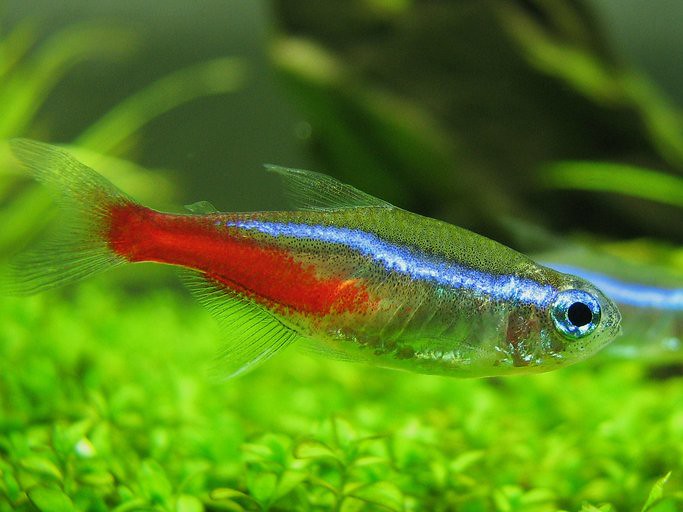
A small freshwater tetra with vivid blue iridescence and a bright red lateral stripe, this fish reaches about 1–1.5 inches and is a peaceful, active schooling species. Its hardiness and low care needs make it a popular beginner choice, but consistent water parameters and keeping a school of at least six are essential for reliable health.
House them in a fully cycled 10+ gallon tank with stable tropical temperatures (70–81°F / 21–27°C), pH near 6.0–7.0 and soft–moderate hardness (2–10 dGH); provide shaded hiding spots using floating plants, driftwood and a darker substrate to mimic blackwater streams. Offer a varied omnivorous diet (quality flakes plus occasional frozen or live foods), remove uneaten food promptly, watch for common problems such as ich, fin rot and a Microsporidian disease first identified in this species, and avoid adding these fish to new or unstable setups; breeding requires very soft, slightly acidic water and low light and is generally more difficult than routine care.
At a Glance
A small, colorful freshwater aquarium fish kept in groups, noted for bright blue iridescence and a red lateral stripe. Hardy with relatively low care needs, neon tetras still require a fully cycled tank, stable tropical temperatures and a school of conspecifics to thrive.
| Species type | Freshwater tetra |
|---|---|
| Adult size | 1–1.5 in (2.5–3.8 cm) |
| Lifespan | 6–8 years |
| Temperament | Peaceful, active, schooling |
| Diet type | Omnivore |
| Tank size | 10 gallons (38 L) |
| Water temperature | 70–81°F (21–27°C) |
| pH range | 6.0–7.0 |
| Care difficulty | Beginner |
| Beginner friendly | Yes, with proper tank setup |
Quick Overview
Suitable for hobbyists who can maintain stable, cycled tropical conditions, neon tetras are often recommended for beginners who plan to keep a proper school and meet basic water requirements. They are prized for compact size and striking blue-and-red coloration, and work well in peaceful community tanks with shaded planting and hiding places.
A small, schooling tetra most notable as a colorful, peaceful addition to planted freshwater aquaria. Key realities: keep in groups of six or more in a matured tank (minimum ~10 gallons), maintain 70–81°F (21–27°C) and pH around 6.0–7.0, feed a varied omnivorous diet, and expect sensitivity to poor water quality and certain diseases; breeding typically requires softer, more acidic water and low light and can be challenging.
Tank & Water Setup
Provide a minimum 10‑gallon (38 L) tank for a small school and add roughly one gallon (≈3.8 L) per additional fish; a wider, rectangular aquarium gives more horizontal swimming space for active schooling. Use a fully cycled, established tank — neon tetras do not tolerate large or frequent changes to water chemistry, so avoid adding them to a new or unstable setup. A running filter is helpful because it aerates water and lowers disease risk, though neon tetras can survive without filtration in some setups; a separate air bubbler is not necessary if plants and a filter provide sufficient oxygenation.
Keep water temperature and chemistry within the species’ known ranges: 70–81°F (21–27°C), pH about 6.0–7.0, and general hardness around 2–10 dGH. Stable water parameters are important for neon tetra health and to reduce stress-related illness. Lighting should be low to moderate—these fish originate from shaded blackwater and clearwater streams and prefer darker, planted environments rather than bright, exposed tanks.
Use a darker substrate (for example black sand) to showcase colors and mimic natural habitat; neon tetras do not dig much, so substrate choice is primarily aesthetic. Decorate with floating plants (hornwort, Java moss), driftwood, and caves to create shaded hiding places and visual cover; darkening three sides of the aquarium can help reproduce low‑light conditions. Keep water clean with regular maintenance and avoid sudden parameter shifts when performing water changes or adding new livestock.
Feeding & Diet
Neon tetras are omnivores and do best on a varied diet that includes both animal and plant-based foods. Quality fortified flakes serve as a staple, supplemented several times per week with frozen or live foods and periodic plant-based items to mirror their natural feeding habits.
Provide dietary variety and avoid overfeeding to reduce disease risk and maintain water quality.
- Main food items
- Quality fish flakes fortified with vitamins and minerals
- Frozen or live foods: bloodworms, daphnia, brine shrimp, tubifex (cut into small pieces as needed)
- Plant-based items: algae wafers, small pieces of grape, cucumber, strawberry
- Feeding frequency
- From six months old: feed twice a day
- Offer live or frozen foods several times per week
- Plant foods up to three times per week
- Feed an amount the school can consume in about two minutes and remove uneaten food
- Foods to avoid
- Uncertified live foods that may carry parasites (risk of neon tetra disease)
- Excessive feeding or leaving uneaten food in the tank
Tank Mates & Compatibility
Neon tetras are peaceful, active schooling fish that do best in groups of six or more and typically occupy the middle of the water column. They may become stressed and show fin‑nipping or hiding behavior if kept alone, in very small numbers, or with aggressive tankmates.
Research compatibility before adding new fish to the tank to ensure matching size, temperament, and water requirements. Suitable companions include similarly sized, non‑aggressive species such as small barbs, small catfish like corydoras, peaceful small gouramis (for example honey gouramis), other small tetra species, and community‑safe invertebrates such as mystery snails and ghost shrimp. Avoid large, territorial, or predatory species and very boisterous tankmates that will harass tetras, outcompete them for food, or require substantially different water chemistry.
Health & Lifespan
Neon tetras typically live 6–8 years in captivity; some wild populations can reach up to about 10 years depending on conditions.
Stable water quality is critical for neon tetra health. Maintain regular water changes, monitor temperature, pH and hardness, quarantine new fish before introducing them to the main tank, and avoid overfeeding to minimize waste buildup and stress-related illnesses.
- Neon tetra disease
- Ich (white spot disease)
- Fin and tail rot
Consistent tank maintenance is the most effective way to prevent disease and keep neon tetras healthy.
Pros & Cons (Honest)
- Hardy and generally low-care compared with many tropical species
- Striking blue-and-red coloration enhances planted tanks
- Compact adult size suitable for smaller aquaria
- Peaceful, schooling behavior fits community setups
- Widely available and affordable
- Require a school (six or more), increasing tank space and stocking needs
- Sensitive to poor water quality and specific diseases (including neon tetra disease)
- Not suitable for new/uncycled tanks—need a mature, stable aquarium
- Breeding is challenging and needs very specific water conditions
Final Considerations
Neon tetras are a strong choice for keepers who can provide a fully cycled 10+ gallon freshwater tank, a school of six or more, and regular maintenance to keep water chemistry stable. Best suited for hobbyists who can maintain stable tropical temperatures, appropriate pH and hardness, and provide shaded, planted cover for schooling behavior.
Those with tanks that house large, aggressive or predatory species, or who cannot commit to routine water testing and maintenance, should reconsider adding neon tetras. Avoid neon tetras if the aquarium contains incompatible tankmates or frequent parameter swings that cannot be controlled.