
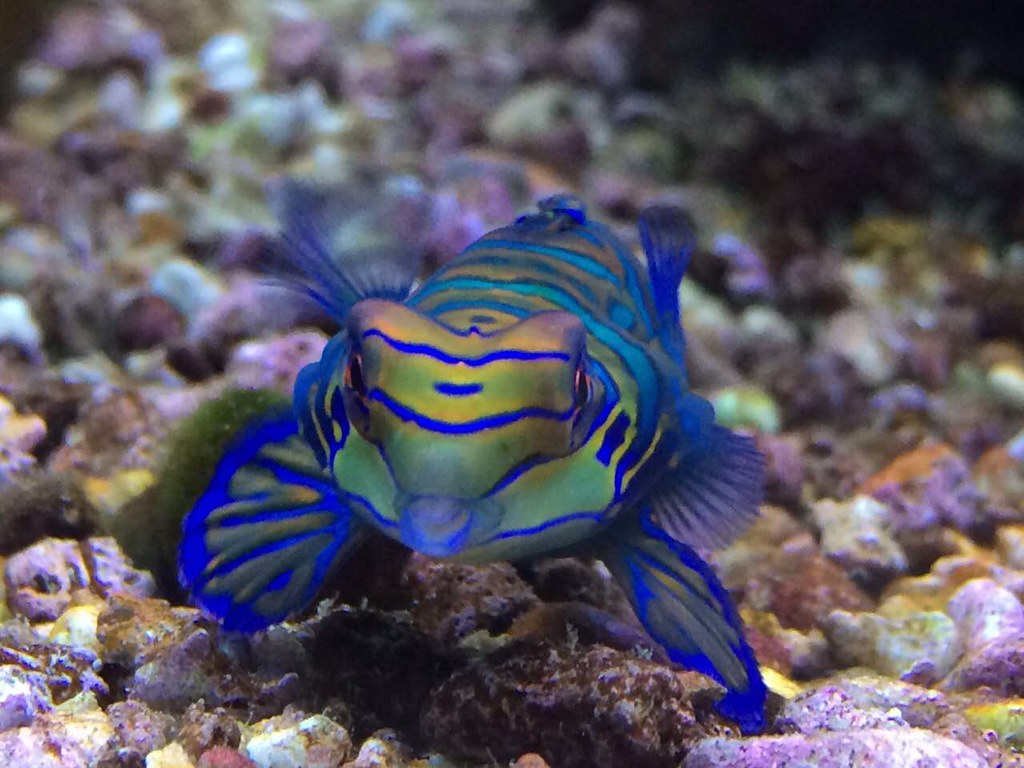
A striking saltwater dragonet in the Callionymidae family, recognized for vivid blue, orange and green patterns, a scaleless body coated in protective mucus, broad head, translucent pectoral fins, and a maximum length of about 3 inches. Peaceful, shy and slow-moving, it spends much of its time foraging on the substrate and is well-suited to a reef community with ample live rock.
Care level is intermediate: provide stable, slow-moving saltwater (72–84°F / 22–28°C; pH 8.1–8.4; salinity 1.023–1.025), a minimum 30-gallon tank for one (75+ gallons recommended for a pair), thick fine sand, plenty of hiding places, and abundant established live rock (~75 lb) to maintain a copepod population. Moderate lighting (9–14 hours/day), gentle filtration and regular partial water changes (≈15% every two weeks) help stability. Dietary needs are specialized—reliant on live copepods and small crustaceans; captive-bred individuals are more likely to accept frozen foods or pellets. Compatible tankmates include docile reef-safe species such as pajama cardinalfish, clownfish, gobies and dartfish; avoid fast-moving, aggressive species and housing multiple males together due to territorial behavior.
At a Glance
The mandarin is a small, brightly colored saltwater dragonet commonly kept in reef community tanks that relies on live rock and abundant microcrustaceans for feeding.
Specialized dietary needs and a dependence on a well-established copepod population make care intermediate and not ideal for novice aquarists.
| Species type | Saltwater dragonet (Callionymidae) |
|---|---|
| Adult size | Up to 3 in (7.6 cm) |
| Lifespan | 2–4 years |
| Temperament | Peaceful, shy, slow-moving |
| Diet type | Carnivore |
| Tank size | Minimum 30 gallons (114 L) |
| Water temperature | 72–84°F (22–28°C) |
| pH range | 8.1–8.4 |
| Care difficulty | Intermediate |
| Beginner friendly | Not recommended for beginners |
Quick Overview
Best suited to aquarists who maintain established reef systems, the mandarin fish is prized for its vivid, intricate coloration and calm, substrate-focused behavior. Its appeal comes from striking appearance and peaceful reef compatibility, but it typically requires a mature tank setup and attentive feeding strategies.
A defining trait is a strong reliance on live copepods and microcrustaceans, which shapes most care decisions for this species. Owners should plan for a well-established live rock population, slow water flow, a minimum 30-gallon environment for a single fish (larger for pairs), and compatible, non-aggressive tankmates; captive-bred individuals are more likely to accept frozen or prepared foods but many remain dependent on live prey.
Tank & Water Setup
A minimum 30-gallon aquarium is required for a single mandarin, with at least 75 gallons recommended for a pair; choose a tank with a broad footprint to maximize live rock and sandy foraging area. Provide a thick layer of fine, soft sand and around 75 pounds of established live rock to sustain a continuous copepod population, plus coral, caves and multiple hiding spots without overcrowding.
Filtration should keep water clean and stable while avoiding strong currents—mandarins prefer slow-moving saltwater and can be stressed by powerful flow near the substrate. Maintain temperature 72–84°F (22–28°C), pH 8.1–8.4, salinity 1.023–1.025, KH 8–12 d and GH 5–15 d. Use moderate lighting (9–14 hours/day) to promote natural algae and microfauna growth. A heater and routine monitoring with a thermometer and pH meter are recommended, and perform partial water changes of about 15% every two weeks (or more often in heavily stocked tanks).
A fully cycled tank with an abundant, established copepod population is essential before adding a mandarin. Stable water parameters are critical to mandarin health and to maintaining their copepod food source. Regular monitoring, gentle maintenance and allowing the system to mature will improve long-term success with this species.
Feeding & Diet
Mandarin fish are carnivores that feed mainly on small crustaceans and other microfauna. In aquaria they depend on a steady supply of live copepods and amphipods and are often reluctant to accept frozen or prepared foods unless captive-bred and weaned.
Provide varied live prey and avoid overfeeding to meet nutritional needs while protecting the tank’s established copepod population.
- Main food items
- Live copepods
- Amphipods
- Bristle worms and other small benthic crustaceans
- Small snails and fish eggs
- Live brine shrimp or mysis shrimp (occasional supplement)
- Feeding frequency
- Continuous grazing
- Often one copepod every 5–10 seconds; up to a few thousand copepods daily
- Foods to avoid
- Relying solely on frozen foods or dry pellets (usually rejected unless captive-bred and trained)
Tank Mates & Compatibility
Mandarin fish are peaceful, shy bottom-dwellers that generally coexist quietly with other non-aggressive reef species; they spend most of their time foraging and avoid confrontation. They are often kept singly or as a bonded male–female pair rather than in groups, since males can become territorial and may fight if housed together.
Suitable tank mates are small, docile, reef-safe fish such as pajama cardinalfish, clownfish, gobies and dartfish; avoid fast-moving, large or aggressive species and fin-nippers that can stress or outcompete mandarins for food. Research compatibility carefully before adding new fish to the tank. Also consider whether potential tankmates will reduce the copepod population or otherwise interfere with the mandarin’s specialized feeding needs.
Health & Lifespan
In captivity mandarin fish typically live 2–4 years; wild individuals can reach up to 15 years.
Mandarins rely on stable, mature systems and good water quality to remain healthy; parameter swings, poor maintenance, and competition that reduces their copepod food supply increase disease risk. Regular partial water changes, routine monitoring of temperature, pH, salinity and hardness, quarantining new fish, and avoiding overfeeding are practical steps to support long-term health.
- Saltwater ICH
- Velvet disease
- Fin rot
- Starvation
Consistent tank maintenance is one of the most effective measures to prevent disease and support mandarin fish health.
Pros & Cons (Honest)
- Striking, vibrant coloration that enhances reef aquariums
- Peaceful, shy temperament compatible with docile reef community fish
- Compact size; fits in a 30‑gallon+ setup for a single fish
- Captive-bred individuals are increasingly available and more likely to accept frozen or pellet foods
- Highly specialized diet; typically requires a stable live copepod population
- Not recommended for beginners due to feeding and tank maturation needs
- Needs abundant established live rock and a mature system, increasing setup cost and time
- Multiple males can be territorial; pairs or single fish are safer
- Risk of starvation if introduced to an undersupplied or immature tank
Final Considerations
Mandarin fish suit aquarists who maintain mature reef systems, prioritize a steady supply of live copepods and microfauna, and can provide slow water flow, abundant live rock and hiding places. Best kept by hobbyists prepared to support a specialized diet and allow the tank to mature before introduction.
They are less appropriate for novice keepers, undersized tanks, or systems with aggressive or fast-moving species that outcompete them for food. Consider alternative reef-safe species if the setup cannot reliably sustain a large copepod population or if regular, targeted maintenance is not feasible.