
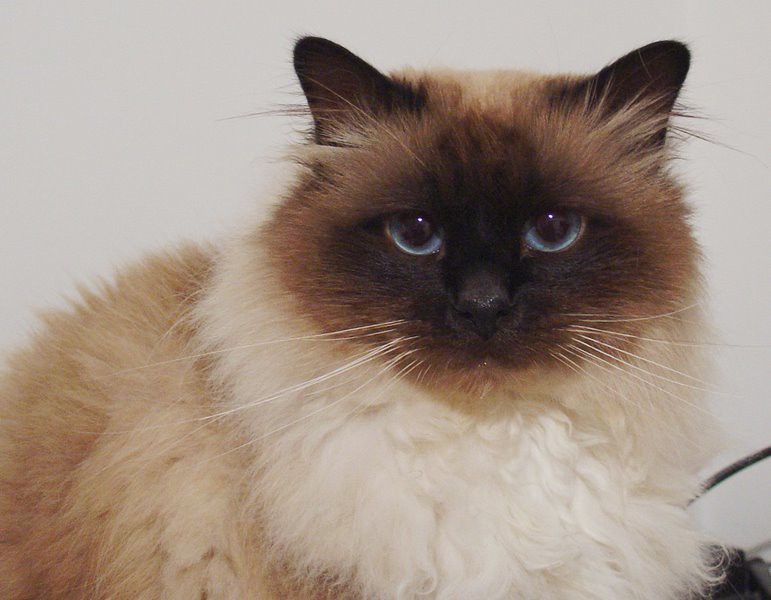
A striking pointed, semi-longhaired cat with a silky, pale coat faintly misted in gold and contrasting darker extremities, finished by deep sapphire-blue eyes. Distinctive white gloves on all four paws and lace-like markings on the hindlegs, paired with a long, sturdy, stocky build, give this breed a dignified yet approachable appearance.
Affectionate and playful, these cats thrive in family homes and often become talkative when engaged by their people; quiet attention tends to reduce vocalizing. Typically medium-to-large and heavily boned, adult cats often weigh around 12 pounds, with males tending to be larger. Care is straightforward: weekly combing with a metal comb (single coat resists matting), more frequent brushing during spring shedding, routine nail/ear/teeth maintenance, high-quality dry kibble, and fresh water (placing the water bowl about three feet from food can encourage drinking). With proper nutrition and regular veterinary care, life expectancy commonly ranges from 9 to 15+ years.
At a Glance
A medium-to-large pointed cat admired for its silky, single-layer coat, white gloves on all four feet, and striking deep sapphire-blue eyes. These gentle, playful companions are affectionate and sociable, often responding vocally when engaged by their owners.
| Origin | France, with traditional ties to Burma |
|---|---|
| Size | Medium-to-large |
| Weight |
|
| Lifespan | 9–15+ years |
| Coat length | Long |
| Colors | Seal, Blue, Chocolate, Lilac, Red, Cream (all pointed colors) |
| Temperament |
|
| Energy level | Medium — enjoys interactive play |
| Vocality | Medium — talkative when engaged, quiet with little response |
| Shedding | Seasonal spring shedding, generally light |
| Grooming needs | Low to Medium — weekly combing, increased during spring shedding |
| Good with children | Often good with children when properly socialized |
Quick Overview
The Birman is a graceful pointed cat with a silky, single-layer coat subtly warmed by a golden hue, striking deep sapphire-blue eyes, and the breed’s hallmark white gloves and lace-like markings on the hindlegs.
Affectionate and playful, Birmans often form close bonds with family members and may become talkative when engaged by their people. They generally balance curiosity and calmness, enjoying interactive play as well as quiet lap time, and require only modest grooming because the single coat tends not to mat.
Temperament & Personality
Birmans are gentle, playful, and affectionate cats that often integrate smoothly into family life and multi-cat homes. They commonly form strong bonds with their people and enjoy regular interaction, becoming quite talkative when engaged.
These cats balance sociability with a degree of independence: they enjoy lap time and will seek play without typically being overly demanding. Owners who respond to their vocalizations should expect more conversation, while quiet attention tends to reduce chatter.
Birmans are generally confident without being brash, showing curiosity toward new people while often remaining composed rather than fearful. Calm, gradual introductions usually produce the best response from strangers and children, as these cats prefer gentle handling and predictable routines.
Family Life: Kids, Cats & Other Pets
Birmans are typically gentle and social, and they often adapt well to family life; with proper handling and early socialization they can be tolerant companions for children. Often good with children when properly socialized, they tend to respond well to calm, consistent interactions and gentle handling. Introductions to young kids should be supervised and include teaching respectful behavior to protect the cat and the child, and multi-cat households usually benefit from gradual, neutral introductions and clearly separated resources.
These cats generally accept other pets more readily than some breeds, but success depends on individual temperament and the other animal’s behavior. With careful, gradual introductions many Birmans live peacefully with dogs, though individual variation means some cats prefer cat-only homes or slow, supervised integration with small animals. Provide safe spaces, separate food and litter areas, and allow pets to set the pace for interaction to improve the chance of a harmonious household.
Activity, Play & Enrichment
Birman cats often show a steady, playful energy and enjoy interactive, social play rather than nonstop high-intensity activity. They typically respond well to toys that mimic prey movement and short games that involve chasing or gentle retrieval.
- Interactive wand and teaser toys — supervised chase and bonding
- Puzzle feeders and treat-dispensing toys — encourage foraging behavior
- Climbing structures and cat trees — vertical territory and safe vantage points
- Window perches and birdwatching spots — visual stimulation from outside activity
- Training games and controlled hide-and-seek — mental challenge and relationship building
Mental and physical stimulation help prevent boredom and encourage healthy behavior in indoor cats by providing outlets for natural instincts.
Light training can add enrichment: try clicker or marker training for simple behaviors, teach name recall and short games, and reinforce calm responses with positive rewards. Keep sessions brief and upbeat to suit the Birman’s sociable, cooperative style.
Grooming, Shedding & Coat Care
The Birman’s single, silky coat is relatively easy to maintain compared with double-coated longhairs, but it still benefits from consistent attention, especially during the seasonal spring molt.
| Coat type | Single, semi-long silky coat |
|---|---|
| Shedding level | Seasonal spring shedding, generally light |
| Grooming frequency | Weekly, increase during spring molt |
| Bathing | Not stated |
| Nail trimming | Regularly, trim as needed |
| Ear care | Regularly, check and clean |
| Teeth brushing | Regularly, use vet-approved toothpaste |
| Matting risk | Low, single coat resists matting |
Health & Lifespan
Life expectancy commonly ranges from 9–15+ years according to the provided facts.
Responsible care supports a long, healthy life: schedule regular veterinary checkups and vaccinations, spay or neuter as recommended, maintain dental hygiene with vet-approved toothbrushing, and manage diet and body condition to avoid excess weight. Routine preventive care and prompt attention to changes in behavior or appetite help detect problems early.
- Specific breed-linked health concerns are not detailed in the provided facts.
When adding a Birman to the home, choose a responsible, ethical breeder or consider adopting from a reputable shelter or rescue to support health and welfare.
Feeding & Nutrition
As obligate carnivores, Birmans benefit from a diet focused on high-quality animal protein. While the breed does not have specific nutritional needs beyond what is typical for cats, the provided facts note that good, quality, dry kibble is acceptable; owners may still choose to include wet food for variety and additional moisture. Consider wet food to increase dietary moisture and dry food for convenience and dental texture, and select formulas matched to the cat’s life stage and activity level.
Feed according to life stage, activity and body condition rather than fixed volumes, following package guidelines and adjusting portions to maintain a healthy weight. Indoor Birmans may need portion control and extra enrichment to avoid excess weight; limit treats and use interactive feeding methods to slow intake and provide mental stimulation. Monitor body condition regularly and consult a veterinarian if weight drifts outside a healthy range.
Consistent diet quality and adequate hydration support long-term health and help prevent weight-related problems. Provide fresh, clean water daily and consider placing the water bowl at least three feet away from food to encourage drinking, or offer a filtered drinking fountain if the cat prefers. Treats are fine in moderation and should be accounted for within the daily calorie plan.
Pros & Cons (Honest)
- Affectionate and forms strong bonds with family
- Playful and social; enjoys interactive play
- Single, silky coat that resists matting
- Often good with other cats and children when properly socialized
- Moderate grooming needs compared with double-coated longhairs
- May become vocal if encouraged by owners
- Seasonal shedding requires more frequent grooming in spring
- Medium-to-large, heavy-boned build can require careful weight management
- Prefers gentle handling and predictable routines
- Individual variation means not every Birman will match breed expectations
Final Considerations
Birman cats often suit owners who want an affectionate, social companion that enjoys interactive play and calm lap time; they fit well in family homes and multi-pet households when introductions are handled thoughtfully. Ideal for people who appreciate a gentle, people-oriented cat with modest grooming needs and a playful streak.
Those who prefer a very independent, low-interaction pet or who cannot provide predictable handling and gradual introductions may want to consider other breeds or wait until the household can meet these needs. Potential owners should be prepared for seasonal shedding, occasional vocalizing when engaged, and attentive socialization to get the best match.