

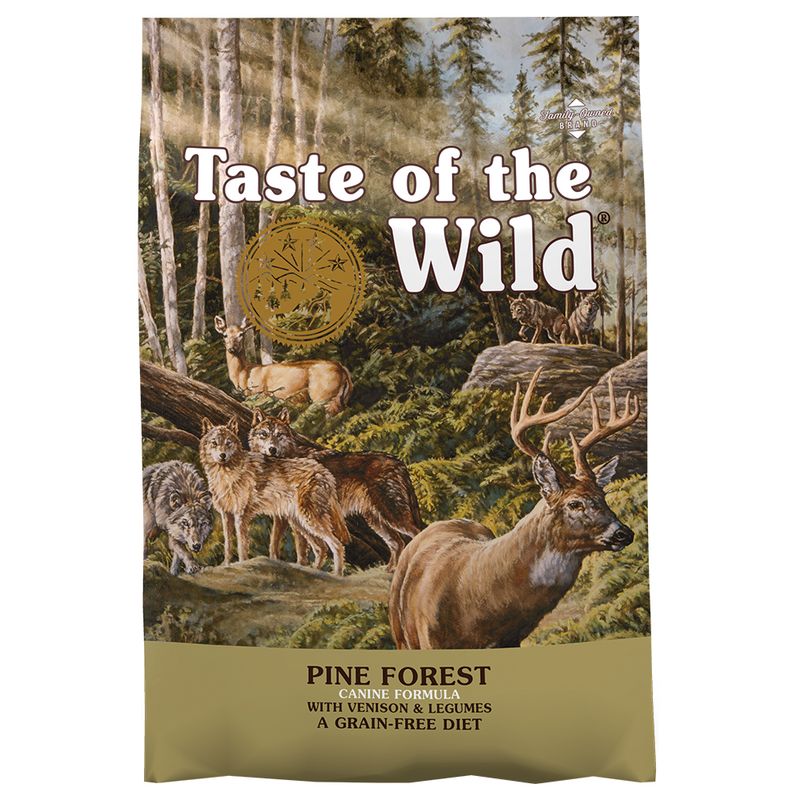
Taste of the Wild – Pine Forest is a grain-free dry formula centered on venison and lamb, with pulses and prebiotics, formulated for all life stages and made in the USA.
This review examines the ingredient mix, analytical constituents and feeding guidelines, labeling claims, and common public feedback on digestibility, coat quality and palatability, aiming to give a clear, fact-based assessment for buyers. Practical feeding recommendations and the declared nutrient profile will also be summarized.
Quick Overview
Taste of the Wild – Pine Forest is a grain-free dry dog food presented for dogs of all ages, sizes and breeds and formulated to meet AAFCO all-life-stages nutrient profiles. The recipe lists venison and lamb as the primary animal-sourced proteins and combines pulses (chickpeas, peas, lentils), salmon and sea fish meal, egg products, rapeseed and salmon oils, plus fruits, vegetables and plant fibres; the product is made in the USA and uses reverse-osmosis purified water in the cooking process.
Core takeaway: the label frames this as a protein-forward, grain-free kibble with added prebiotics, omega fatty acids and antioxidants suitable for broad life-stage feeding. The package includes detailed analytical constituents, additives and step-by-step feeding guidelines, but it does not provide caloric density (kcal/kg or per cup) or third‑party certification details in the provided facts, so those specifics are unknown from the label information supplied.
At a Glance
This quick table summarises only information explicitly stated on the product label or product page for Taste of the Wild – Pine Forest. The focus is on declared format, life-stage suitability, primary proteins, package options and regulatory notes; no inferences are made.
| Food type | Dry |
|---|---|
| Diet completeness | Complete dry food for dogs of all ages |
| Life stage | All life stages |
| Size or breed targeting | All sizes and breeds |
| Main protein or flavor | Venison and lamb |
| Package sizes |
|
| Calorie or energy information | Not stated |
| Country of manufacture | Made in the USA |
| Nutritional standard | Formulated to meet AAFCO recommended nutrient profiles |
Ingredients & Nutrition
Below is a label-based breakdown of the declared ingredients and the guaranteed analysis for Taste of the Wild – Pine Forest, using only information provided on the product page or packaging.
| Main protein sources |
|
|---|---|
| Carbohydrate or fiber sources |
|
| Fats or oils |
|
| Added vitamins, minerals, or supplements |
|
The guaranteed analysis lists crude protein 28.0%, crude fat 15.0%, crude fibre 4.5%, ash 6.9%, and moisture 10.0%. Omega values are declared as omega-3 fats 0.3%, omega-6 fats 2.8%, and DHA 0.05%.
In plain terms, the label shows a relatively high protein level for a dry food and a moderate fat level; higher protein percentages generally indicate a greater proportion of protein relative to carbohydrates and can reflect the presence of several named protein sources on the ingredient list. The declared omega-3 and omega-6 amounts indicate the product provides measurable unsaturated fatty acids. Label-based observation: the recipe explicitly lists multiple named animal proteins (venison, lamb meal, sea fish meal, egg products), several pulses as declared at 10% each, and specified vitamin and mineral additives. What is not stated on the provided label information is the caloric density (kcal per kg or per cup) and any third‑party certifications; those specifics are unknown from the supplied facts.
Best Feeding Guide
This section summarises the manufacturer’s daily feeding recommendations as declared on the product label. The table below presents the suggested daily amounts for different weight ranges and life stages so readers can compare guidance for puppies and adult dogs without inference.
| Dog’s weight | 6-12 weeks | 3-4 months | 5-7 months | 8-12 months | Adult |
|---|---|---|---|---|---|
| 1 – 2.25kg | 75 – 125g | 75 – 100g | 66 – 100g | 50 – 75g | 33 – 50g |
| 2.25 – 4.5kg | 125 – 200g | 100 – 175g | 100 – 166g | 75 – 133g | 50 – 66g |
| 4.5 – 9kg | 200- 325g | 175 – 300g | 166 – 275g | 133 – 225g | 66 – 100g |
| 9 – 13.5kg | 325 – 433g | 300 – 400g | 275 – 366g | 225 – 300g | 100 – 175g |
| 13.5 – 18kg | 433 – 550g | 400 – 500g | 366 – 450g | 300 – 366g | 175 – 233g |
| 18 – 27kg | 550 – 750g | 500 – 666g | 450 – 625g | 366 – 500g | 233 – 300g |
| 27 – 36kg | – | 666 – 850g | 625 – 766g | 500 – 625g | 300 – 400g |
| 36 – 45kg | – | – | 766 – 900g | 625 – 725g | 400 – 500g |
| 45 – 57kg | – | – | – | 725 – 850g | 500 – 575g |
| 57 – 68kg | – | – | – | 850 – 975g | 575 – 675g |
| 68 – 79kg | – | – | – | 975 – 1050g | 675 – 866g |
Please note that these amounts are the manufacturer’s guidelines. Actual feeding needs depend on a dog’s age, activity level and individual circumstances; monitor body condition and adjust portions as required. Introduce new food slowly and ensure fresh water is available at all times.
Users Commonly Mention
This section summarises recurring themes from available user reviews on retailer platforms and sites included in the provided context. Points below reflect aggregated mentions across those reviews rather than individual endorsements.
- Dogs commonly accept the food and reviewers report repeat purchases. Several reviews note that pets enjoy the flavour and owners reorder.
- Some reviewers report improvements in digestion and stool quality, mentioning firmer stools and reduced flatulence in individual cases.
- Multiple users with dogs described as having sensitive stomachs or skin indicate the product was suitable for their pets where other foods had not agreed.
- A few comments note the kibble size may be large for cats or very small animals, which could be inconvenient for those feeding smaller mouths.
Good & Bad
Below is a balanced list of label-based strengths and limitations for Taste of the Wild – Pine Forest, drawn from the provided product facts and the user comments included in the context.
- Grain-free dry formula with named animal proteins—venison (deer listed at 10%) and lamb meal—and several other named protein sources (sea fish meal, egg products).
- Declared functional ingredients: prebiotic source (dried chicory roots), omega sources (salmon oil, rapeseed oil) and fruit/vegetable antioxidants; guaranteed analysis shows 28.0% protein and 15.0% fat.
- Formulated for all life stages and accompanied by detailed feeding guidelines; label states formulation meets AAFCO recommended nutrient profiles and product is made in the USA.
- Label explicitly states exclusions such as no slaughterhouse waste, no vegetable or animal by-products, and no taste enhancers or attractants.
- Caloric density (kcal per kg or per cup) is not stated in the provided facts, so energy content per serving is unknown from the label information supplied.
- No third‑party certifications or external verification details are provided in the supplied facts.
- The recipe lists multiple pulses (chickpeas, peas, lentils at declared 10% levels), which may be relevant to buyers tracking legume content—this is a label fact rather than a value judgement.
- Some user comments note the kibble size can be large for smaller mouths (commentary referenced cats/smaller animals), which could affect suitability for very small dogs or multi-pet households.